Preparing for entrance examinations such as JEE, NEET and other competitive tests is an important part of intermediate education. However, a student’s future success depends on much more than entrance exam scores. The right junior college should help students develop communication, critical thinking, leadership, problem-solving, adaptability and decision-making skills that remain valuable throughout higher education and professional life.
Choosing the Best Junior College in Hyderabad therefore means looking beyond marks and rankings. Students and parents should consider whether a college provides an environment where academic learning is combined with personal development, practical exposure and career awareness.
According to India’s National Education Policy (NEP) 2020, education should focus on holistic development, conceptual understanding, creativity, critical thinking, communication, teamwork and resilience rather than focusing only on examination-oriented learning.
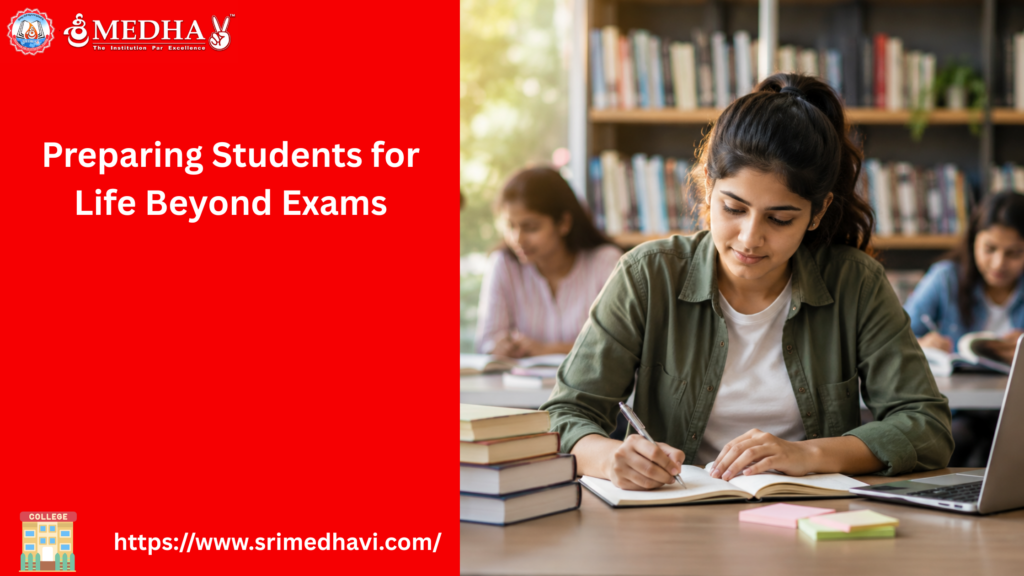
What Does “Life Beyond Entrance Exams” Mean?
Life beyond entrance exams refers to the stage when students move into universities, professional courses, workplaces and independent adult life.
After JEE, NEET or other entrance examinations, students are expected to:
- Communicate effectively
- Work with different people
- Solve unfamiliar problems
- Manage their time independently
- Make informed decisions
- Adapt to new environments
- Handle academic and personal responsibilities
- Use technology effectively
- Develop professional behaviour
- Continue learning throughout their careers
A junior college that prepares students for these abilities gives them an advantage beyond the entrance examination.
How Can the Best Junior College in Hyderabad Prepare Students for the Future?
1. Building Strong Communication Skills
Academic knowledge is important, but students also need to communicate their ideas clearly.
Junior colleges can develop communication skills through:
- Presentations
- Group discussions
- Debates
- Seminars
- Classroom interactions
- Public-speaking activities
- Written assignments
Students who learn to express their thoughts confidently are better prepared for university presentations, interviews, projects and professional communication.
For students and parents researching the Best Junior College in Hyderabad, communication development should therefore be one of the factors considered during college selection.
2. Developing Critical Thinking
Entrance examinations test problem-solving ability, but real-world problems are often different from textbook questions.
Students need to learn how to:
- Analyse information
- Identify the actual problem
- Compare different solutions
- Question assumptions
- Make logical decisions
- Apply knowledge to unfamiliar situations
The Ministry of Education highlights critical thinking, creativity, conceptual understanding and learning beyond rote memorisation as important educational goals.
A strong academic environment should therefore encourage students to understand why an answer is correct instead of simply memorising it.
3. Encouraging Problem-Solving and Practical Learning
Problem-solving is useful in every career.
Whether students eventually become doctors, engineers, entrepreneurs, researchers, accountants or professionals in another field, they will encounter situations that do not have straightforward answers.
Junior colleges can encourage problem-solving through:
- Projects
- Practical activities
- Experiments
- Case-based discussions
- Team assignments
- Research activities
- Real-world examples
This approach helps students connect classroom concepts with situations outside the examination hall.
4. Developing Time-Management Skills
Intermediate students often manage board examinations, entrance-exam preparation, assignments, revision and personal activities simultaneously.
Learning to manage time during junior college can prepare students for the greater independence they will experience at university.
Students can learn to:
- Set academic priorities.
- Create realistic schedules.
- Break large tasks into smaller goals.
- Allocate time for revision.
- Avoid unnecessary distractions.
- Review their progress regularly.
These habits can become valuable long after entrance examinations are completed.
5. Encouraging Teamwork
Many students spend most of their preparation time studying individually. However, higher education and professional careers frequently involve collaboration.
Team-based activities can teach students how to:
- Listen to others
- Share responsibilities
- Respect different opinions
- Resolve disagreements
- Contribute ideas
- Work toward a common goal
The NEP 2020 specifically identifies cooperation, teamwork and resilience among important life skills.
This is another reason parents should look beyond examination results when evaluating the Best Junior College in Hyderabad.
6. Developing Leadership Qualities
Leadership does not necessarily mean becoming the class representative or team captain.
A good junior college can provide opportunities for students to take responsibility through:
- Student activities
- Academic projects
- Events
- Clubs
- Competitions
- Team assignments
- Presentations
Leadership experiences help students become more confident in making decisions and taking responsibility for their actions.
7. Providing Career Awareness
Students may know that they want to pursue engineering or medicine, but many do not understand what university life and professional careers actually involve.
Career guidance can help students understand:
- Higher education options
- Different career pathways
- Course requirements
- Emerging career fields
- Skills required for different professions
- Long-term career planning
This becomes especially important when students are choosing an intermediate stream after Class 10.
A college’s responsibility should not end with helping students secure an entrance-exam rank. It should also help students understand where that academic journey can lead.
8. Teaching Digital and Technology Skills
Technology is now part of almost every academic and professional environment.
Students should gradually learn how to use technology responsibly for:
- Research
- Presentations
- Collaboration
- Learning
- Information management
- Digital communication
The Ministry of Education also recognises the importance of technology in education and skill development.
However, digital literacy should also include understanding responsible technology use, information quality and online safety.
9. Encouraging Creativity
Creativity is useful far beyond traditionally creative professions.
Students can develop creativity by being encouraged to:
- Explore different solutions
- Ask questions
- Participate in competitions
- Work on projects
- Experiment with ideas
- Present information in different formats
The goal is to create students who can think independently rather than simply reproduce information.
10. Building Emotional Resilience
Intermediate education can be academically demanding. Students may experience exam pressure, competition, uncertainty about careers and fear of failure.
A supportive college environment can help students develop resilience by teaching them that setbacks are opportunities to learn.
Students should gradually learn to:
- Handle disappointing results
- Accept constructive feedback
- Recover from mistakes
- Set new goals
- Maintain consistency
- Ask for help when necessary
Resilience is a skill that remains valuable throughout university and professional life.
Why Life Skills Matter Alongside Entrance Exam Preparation
Entrance examinations may determine admission to a particular course or institution, but they do not completely determine long-term success.
For example, a student may secure an excellent entrance rank but later need to give presentations, participate in team projects, communicate with professors, manage deadlines and make independent decisions.
Therefore, the ideal intermediate education model combines academic preparation with life skills.
CBSE’s skill-education framework similarly recognises employability and skill development alongside academic education.
What Should Parents Look for When Choosing a Junior College?
Parents searching for the Best Junior College in Hyderabad should consider more than tuition, examination results or infrastructure.
Important questions include:
- Does the college focus on conceptual understanding?
- Does it provide career guidance?
- Are students encouraged to communicate and participate?
- Are practical and project-based activities included?
- Does the college monitor academic progress?
- Is there appropriate mentoring and student support?
- Does the environment encourage discipline and independence?
- Are students exposed to activities beyond textbook learning?
- Does the college prepare students for university life as well as entrance examinations?
Parents can also explore the Sri Medhavi Junior College website to learn more about the institution and its educational approach.
How Sri Medhavi Junior College Can Support Holistic Student Development
For a junior college, the objective should be to create students who are academically prepared, confident and capable of handling new challenges.
At Sri Medhavi Junior College, students can benefit from an educational environment that aims to support academic preparation while encouraging discipline, personal development and future-focused learning.
Parents can also explore the college’s Gallery to get a better visual understanding of the campus and student environment.
When comparing options, students should focus on finding a Best Junior College in Hyderabad that matches their academic goals, learning style and long-term career aspirations rather than choosing a college based on a single factor.
Frequently Asked Questions
1. Why should junior colleges focus on skills beyond entrance exams?
Entrance exams test specific academic abilities, but students also need communication, teamwork, critical thinking, time management and problem-solving skills for university and professional life.
2. What skills should students develop during intermediate education?
Important skills include communication, critical thinking, teamwork, leadership, time management, problem-solving, digital literacy, creativity and resilience.
3. How can a junior college prepare students for university life?
Colleges can provide presentations, projects, group activities, career guidance, practical learning and opportunities for students to take responsibility.
4. Is entrance-exam preparation enough for a student’s future?
No. Entrance-exam preparation is important for admission, but long-term success also requires academic understanding, interpersonal skills, adaptability and independent decision-making.
5. What should parents look for in the Best Junior College in Hyderabad?
Parents should evaluate academic quality, mentoring, career guidance, learning environment, student development, discipline, practical exposure and preparation for both higher education and future careers.
Conclusion
The role of a junior college should extend beyond preparing students for entrance examinations. Intermediate education is an important stage where students can develop the academic foundation, confidence and life skills needed for higher education and future careers.
The Best Junior College in Hyderabad should therefore provide more than exam preparation. It should encourage students to think critically, communicate confidently, work collaboratively, manage their time, solve problems and adapt to new challenges.
When parents and students evaluate junior colleges, they should ask a broader question: “Will this college prepare the student not only to enter a good university but also to succeed after getting there?”
A future-ready approach to intermediate education can help students move beyond entrance-exam scores and become confident, responsible and adaptable individuals prepared for the next stage of life.