Balancing board exams with competitive entrance exams such as JEE and NEET can be challenging for Intermediate students. Both require consistent preparation, strong conceptual understanding, regular revision, and effective time management. However, students do not necessarily need separate preparation for every subject. With the right strategy, board exam preparation and competitive exam preparation can complement each other.
Students studying in the Best Junior Colleges in Hyderabad often follow structured academic schedules that allow them to manage classroom learning, competitive exam preparation, revision, tests, and self-study more effectively. The key is to understand how to divide your time and identify which areas need more attention.
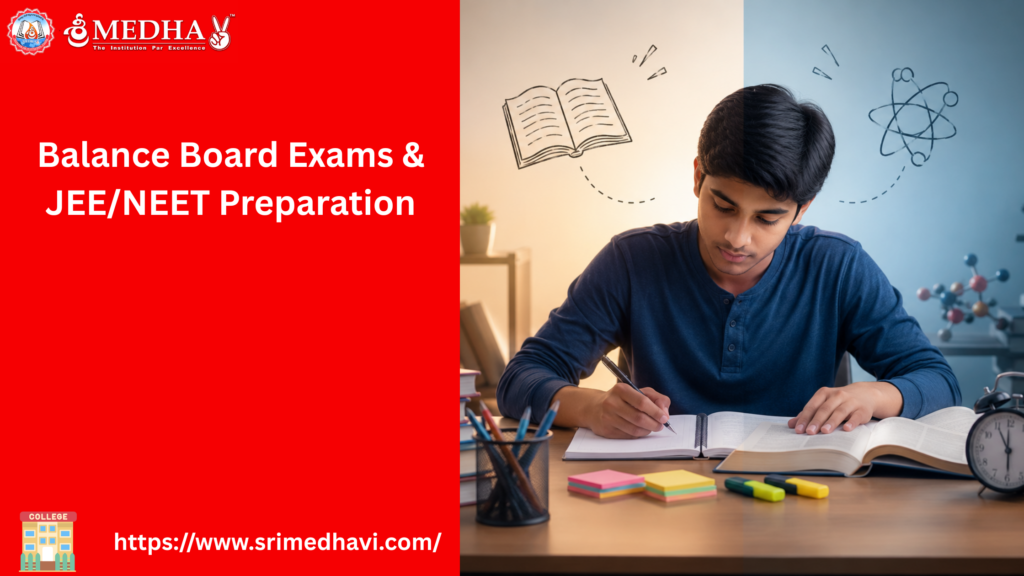
How Can Students Balance Board Exams and JEE/NEET Preparation?
The best way to balance both is to build a study plan around the common syllabus first and then give additional time to competitive-exam-level questions. Students should:
- Understand concepts thoroughly instead of relying only on memorisation.
- Complete board syllabus topics systematically.
- Practise JEE/NEET objective questions alongside relevant chapters.
- Keep separate time for revision and mock tests.
- Analyse mistakes after every test.
- Increase board-focused revision closer to Intermediate examinations.
- Maintain sufficient sleep, breaks, and physical activity.
The Best Junior Colleges in Hyderabad can support this process by providing an integrated academic environment where Intermediate education and entrance-exam preparation are planned together.
Why Is Balancing Board Exams and Competitive Exams Difficult?
Board examinations and entrance examinations may test students in different ways. Board exams generally require students to demonstrate their understanding through prescribed academic content and written answers, while entrance examinations place significant emphasis on speed, accuracy, conceptual application, and objective questions.
For JEE aspirants, the official JEE Main website provides the current examination information and syllabus, which students should use when planning their preparation. Similarly, NEET aspirants should refer to the official NTA NEET website and its current syllabus and information bulletin rather than relying on outdated preparation material.
This means students need a strategy that covers both depth of understanding and speed of application.
- Start With the Common Syllabus
One of the biggest mistakes students make is treating board preparation and JEE/NEET preparation as completely separate activities.
Instead, identify chapters that overlap between the Intermediate syllabus and competitive-exam syllabus. Study the chapter conceptually first, then move towards objective questions and application-based problems.
For example:
- Study the Physics concept from the prescribed syllabus.
- Understand the important formulas and principles.
- Solve board-level questions.
- Move to JEE-level numerical problems or NEET-style objective questions, depending on your target.
- Revise the same chapter later using short notes.
This approach saves time because one study session serves multiple purposes.
Students researching the Best Junior Colleges in Hyderabad should therefore look beyond marks and compare how colleges structure academics, competitive preparation, revision, and testing.
- Create a Realistic Daily Study Schedule
A timetable should be practical rather than excessively ambitious.
A student might divide a weekday into:
Morning:
Quick revision of formulas, definitions, diagrams, reactions, or previously studied concepts.
College hours:
Focus completely on classroom teaching and clarify doubts immediately.
Evening:
Complete assignments and revise the concepts taught during the day.
Night:
Practise competitive-exam questions based on the same topics.
The exact schedule will vary depending on the student’s stream, academic level, travel time, and examination calendar.
The Best Junior Colleges in Hyderabad often provide structured schedules because consistency is particularly important when students are preparing for two demanding examination patterns simultaneously.
- Give Priority to Concepts Before Speed
Competitive examinations can tempt students to focus heavily on shortcuts and question-solving speed. However, shortcuts are useful only after the underlying concept is clear.
A better sequence is:
Concept → Examples → Board Questions → Objective Questions → Timed Practice → Revision
For JEE students, this is particularly important in Physics, Chemistry, and Mathematics. For NEET aspirants, strong conceptual understanding in Physics, Chemistry, and Biology forms the foundation for objective-question practice.
Rather than trying to solve hundreds of questions without understanding them, students should identify why they made mistakes and revisit the underlying concept.
- Use Board Preparation to Strengthen Competitive Preparation
Board preparation should not always be viewed as an additional burden.
Writing detailed answers, learning definitions, practising derivations, understanding diagrams, and revising textbook concepts can strengthen the foundation required for entrance examinations.
For NEET preparation, for instance, students should pay close attention to the prescribed Biology and Chemistry concepts. The official NTA NEET website publishes examination information and the applicable syllabus, making it an important reference point for students.
Similarly, JEE aspirants should regularly verify their preparation against the official JEE Main syllabus and information bulletin.
- Divide Your Week Into Different Study Goals
Instead of studying every subject equally every day, students can assign specific goals to different days.
For example:
Day | Main Focus |
Monday | Physics concepts + objective practice |
Tuesday | Chemistry concepts + revision |
Wednesday | Mathematics/Biology practice |
Thursday | Weak-topic improvement |
Friday | Mixed competitive questions |
Saturday | Board-oriented revision |
Sunday | Mock test + mistake analysis |
This is only an example. Students should modify it according to their own syllabus and upcoming examinations.
The most important part is maintaining a balance between learning, practice, revision, and testing.
- Use Short Revision Sessions
Students do not always need several uninterrupted hours to revise.
Short revision sessions can be extremely useful for:
- Physics formulas
- Chemistry reactions
- Biology diagrams and terminology
- Mathematics formulas
- Important definitions
- Frequently repeated mistakes
- Difficult concepts
A 20–30 minute revision session can be included during breaks or at the beginning or end of a study session.
This technique is especially useful for students who are trying to balance college classes with entrance-exam preparation.
- Maintain a Mistake Notebook
One of the simplest ways to improve competitive-exam performance is to record mistakes.
After every test, classify mistakes into categories such as:
- Conceptual mistake
- Calculation mistake
- Misreading the question
- Formula mistake
- Time-management mistake
- Guessing error
Review this notebook regularly.
For example, if a student repeatedly makes mistakes in a particular Physics chapter, simply solving more questions may not be enough. The student should return to the concept, identify the gap, and then practise again.
This type of performance analysis is one reason many students consider the academic monitoring system when comparing the Best Junior Colleges in Hyderabad.
- Increase Board Preparation Before Board Exams
Students should not wait until the last few weeks to begin board revision.
As board examinations approach, gradually increase the proportion of board-focused preparation.
For example:
Several months before boards:
Balanced preparation for boards and JEE/NEET.
1–2 months before boards:
Greater emphasis on textbook revision, written practice, previous papers, and board-style questions.
Final weeks:
Strong focus on board examination revision while maintaining limited competitive-exam practice to avoid losing continuity.
After the board examinations, students can redirect their attention towards entrance-exam preparation according to their examination schedule.
- Take Mock Tests Seriously
Mock tests are not just for checking marks.
They help students understand:
- How much time they need per section
- Which topics are weak
- Whether they make careless mistakes
- How well they handle exam pressure
- Which questions should be attempted first
Students should spend almost as much time analysing a test as they spend taking it.
For JEE preparation, students can refer to the official NTA JEE Main resources for examination information. NEET aspirants should similarly use the official NTA NEET resources for current examination updates and documents.
- Do Not Sacrifice Sleep for Study Hours
Studying late into the night every day may appear productive, but inadequate sleep can affect concentration, memory, and problem-solving ability.
Students should aim for a consistent sleep schedule and take short breaks during longer study sessions.
A balanced routine should include:
- Regular sleep
- Healthy meals
- Short breaks
- Physical activity
- Focused study periods
- Time away from screens
The goal is not to study every waking hour. The goal is to make study hours more productive.
How Can the Right Junior College Help?
Choosing a junior college can make a significant difference because students spend a substantial part of their Intermediate years in that academic environment.
When comparing the Best Junior Colleges in Hyderabad, students and parents can evaluate:
- Faculty experience
- Academic timetable
- Competitive-exam preparation
- Regular examinations
- Doubt-clearing support
- Individual performance tracking
- Study environment
- Library and learning resources
- Student mentoring
- Revision strategy
- Residential facilities, where applicable
A college that integrates these elements can reduce the need for students to independently coordinate every aspect of their preparation.
Students and parents can also explore Sri Medhavi Junior College to understand its academic environment and approach to Intermediate education.
JEE vs NEET: Should the Preparation Strategy Be Different?
Yes. Although both examinations require strong conceptual preparation, the subject requirements and question-solving approaches differ.
For JEE Aspirants
Students should focus heavily on:
- Physics problem-solving
- Chemistry concepts and application
- Mathematics practice
- Numerical accuracy
- Time management
- Regular objective tests
The official JEE Main syllabus should remain the primary reference when planning preparation.
For NEET Aspirants
Students should focus heavily on:
- Biology concepts and revision
- Physics numerical practice
- Chemistry concepts and questions
- Accuracy
- Repeated revision
- Full-length objective tests
Students should refer to the official NEET syllabus and examination information published by NTA for the relevant examination year.
A Simple Weekly Strategy for Intermediate Students
A balanced weekly approach could look like this:
Monday to Friday:
Focus on classroom learning, daily revision, assignments, and topic-wise competitive questions.
Saturday:
Revise the week’s syllabus and complete pending topics.
Sunday:
Take a mock or chapter test, analyse mistakes, and prepare the following week’s study plan.
This creates a continuous cycle:
Learn → Practise → Test → Analyse → Revise → Improve
Following this cycle consistently is more effective than studying large portions of the syllabus randomly.
Frequently Asked Questions
Can I prepare for board exams and JEE/NEET at the same time?
Yes. The two preparation paths can be combined effectively because many concepts overlap. The key is to study the common syllabus thoroughly and then increase objective-question practice for the relevant entrance examination.
How many hours should an Intermediate student study every day?
There is no universal number of hours that works for every student. Study time should depend on the student’s academic level, college schedule, syllabus progress, and examination timeline. Focused and consistent study is more important than simply counting hours.
Should board exams or JEE/NEET get more priority?
The priority should change according to the examination calendar. During regular academic months, students can maintain a balance. As board examinations approach, board-focused revision should increase. After boards, students can concentrate more heavily on entrance examinations.
Is integrated coaching useful for JEE and NEET preparation?
Integrated preparation can help students coordinate Intermediate academics and competitive-exam preparation within one structured schedule. However, its effectiveness depends on teaching quality, testing, doubt support, individual attention, and how consistently the student follows the programme.
How do I choose among the Best Junior Colleges in Hyderabad?
Compare colleges based on academics, faculty, competitive preparation, student support, testing systems, learning environment, and overall suitability for the student’s career goal rather than selecting a college based only on advertisements or rankings.
CTA
Balancing board exams with JEE or NEET preparation is possible when students follow a structured and realistic strategy. Instead of treating the two examinations as completely separate goals, students should use their Intermediate syllabus as the foundation and gradually build competitive-exam-level problem-solving and objective-question practice around it.
The Best Junior Colleges in Hyderabad can provide a structured environment that helps students manage academics, competitive preparation, testing, revision, and mentoring more efficiently. However, the student’s own consistency remains equally important.
Start with clear goals, follow a manageable timetable, revise regularly, analyse mistakes, and adjust the study plan as examinations approach. With disciplined preparation and the right academic support, students can work towards strong board performance while continuing their JEE or NEET preparation.
Looking for a structured Intermediate learning environment? Explore Sri Medhavi Junior College and learn more about its academic approach and student-focused programmes.