Intermediate education is one of the most important stages in a student’s academic journey. After completing Class 10, students enter a phase where academic expectations increase, career choices become more serious, and preparation for competitive examinations such as JEE, NEET, CA, and other professional courses begins to take shape. At this stage, choosing one of the Best Junior Colleges in Hyderabad is not only about infrastructure, rankings, or examination results. It is also about the quality of interaction students receive from their teachers.
A strong student-teacher relationship can make learning more comfortable, personalized, and meaningful. Teachers who understand their students can identify their strengths, recognize learning difficulties, provide timely guidance, and encourage them to keep improving.
For parents searching for the Best Junior Colleges in Hyderabad, student-teacher interaction should therefore be an important factor when comparing colleges.
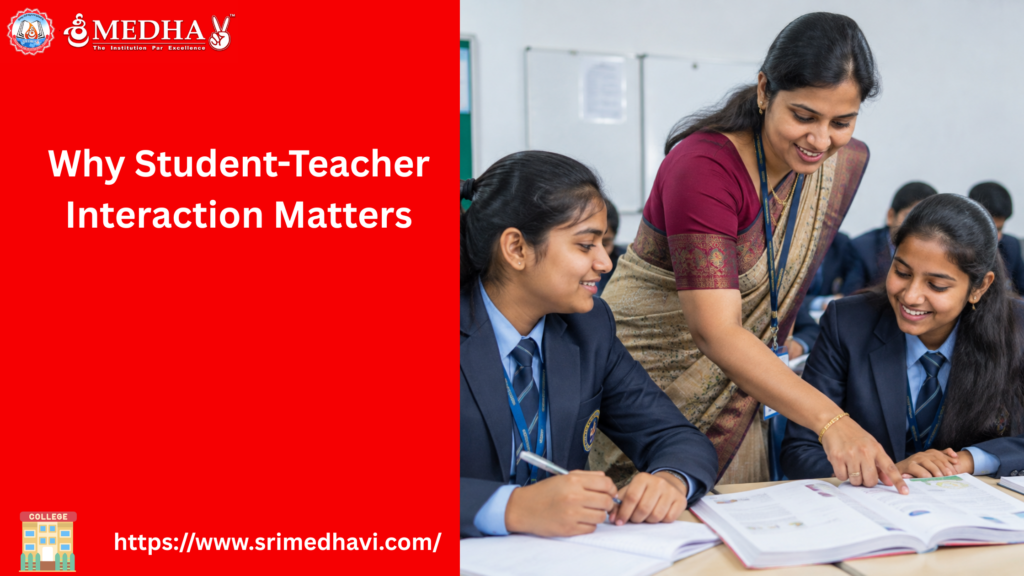
Why Student-Teacher Interaction Is Important During Intermediate Education
Intermediate education brings a major transition in a student’s life. The syllabus becomes more advanced, study schedules become more demanding, and students are expected to take greater responsibility for their academic performance.
During this period, students may hesitate to ask questions, struggle with difficult concepts, or feel pressure about examinations and career decisions. A supportive teacher can make a significant difference.
Research has consistently associated positive teacher-student relationships with student engagement and academic outcomes. A meta-analysis covering 99 studies found that positive teacher-student relationships were associated with stronger student engagement and academic achievement, with effects becoming particularly relevant in higher grades.
This makes meaningful interaction especially valuable in intermediate education.
- Teachers Can Understand Individual Learning Needs
Every student learns differently. Some students understand concepts quickly, while others require additional explanations, examples, or practice.
In a large classroom where there is little interaction, it can be difficult for teachers to identify these differences. However, regular communication allows teachers to understand where individual students are struggling.
For example, a student may perform well in Physics but struggle with Mathematics. Another student may understand classroom lessons but have difficulty applying concepts in competitive-exam questions.
Teachers at the Best Junior Colleges in Hyderabad can use regular interaction to identify these learning gaps and provide appropriate guidance.
Personalized instruction is increasingly recognized as an important part of effective teaching. The OECD notes that adapting instruction to students’ individual needs and providing individual support is associated with stronger teacher-student relationships and teacher confidence.
- Students Become More Comfortable Asking Questions
One of the biggest barriers to learning is the fear of asking questions.
Students sometimes avoid asking questions because they worry that their classmates may judge them or that the teacher may consider the question too simple. When teachers create an approachable classroom environment, students become more confident about expressing their doubts.
This is particularly important during intermediate education because subjects such as Mathematics, Physics, Chemistry, Biology, Economics, and Accountancy can involve complex concepts.
When students regularly interact with teachers, they are more likely to say:
- “I didn’t understand this concept.”
- “Can you explain this problem again?”
- “Why is this formula used here?”
- “How should I prepare for this examination?”
- “Which topics should I revise first?”
This type of communication transforms the classroom from a one-way lecture environment into an interactive learning space.
- Better Interaction Can Improve Student Engagement
Students learn more effectively when they feel connected to the learning process.
Simply attending classes does not necessarily mean that a student is actively learning. Students need opportunities to participate, ask questions, discuss ideas, solve problems, and receive feedback.
The OECD’s recent research on teacher support highlights that students who feel supported by their teachers tend to show stronger engagement with learning, higher achievement, and a stronger sense of belonging.
This is one reason why parents looking for the Best Junior Colleges in Hyderabad should look beyond marks and consider how teachers communicate with students.
A college that encourages classroom participation can help students become active learners rather than passive listeners.
- Teachers Can Identify Academic Problems Early
A student may not always openly tell parents that they are struggling academically.
Sometimes declining marks, incomplete assignments, reduced classroom participation, or repeated mistakes may be the first signs of an academic problem.
Teachers who interact regularly with students can identify these changes early.
For example, if a student who normally participates actively suddenly stops answering questions, a teacher may notice the change and speak with the student. The reason could be a difficult topic, lack of confidence, poor preparation, or difficulty managing the workload.
Early identification allows teachers and parents to work together before a small academic issue becomes a major problem.
This kind of continuous support is an important characteristic parents should consider while evaluating the Best Junior Colleges in Hyderabad.
- Student-Teacher Interaction Supports Competitive Exam Preparation
Intermediate students often prepare for board examinations while simultaneously working toward competitive examinations.
JEE and NEET preparation, for example, requires conceptual clarity, consistent practice, revision, and regular performance analysis.
Students can easily become confused about how to divide their time between different subjects.
Teachers can help students understand:
- Which topics require more attention
- How to approach difficult chapters
- How to revise effectively
- How to analyse mistakes
- How to prepare for mock tests
- How to manage board and competitive examination preparation
This guidance can be particularly valuable in colleges that integrate academic education with competitive-exam preparation.
Students considering the Best Junior Colleges in Hyderabad should therefore ask whether teachers are available to guide students beyond regular classroom teaching.
- Regular Feedback Helps Students Improve
Feedback is one of the most important parts of education.
Students need to know not only what they got wrong but also why they made a mistake and how they can avoid making it again.
For example, instead of simply saying that an answer is incorrect, a teacher can explain where the student’s reasoning went wrong and demonstrate a better approach.
Regular feedback helps students understand their progress.
It can also encourage students to set realistic academic goals.
A teacher might tell a student:
“You have improved significantly in Chemistry, but your numerical problem-solving needs more practice.”
Such feedback is more useful than simply receiving a percentage or rank.
The OECD emphasizes the importance of teachers supporting students through instructional practices, social-emotional support, and classroom interaction.
- Interaction Builds Student Confidence
Academic confidence does not develop overnight.
Students become confident when they experience progress, receive constructive feedback, and know that someone is available to guide them when they face difficulties.
A teacher who recognizes improvement can motivate a student to continue working.
For example, a student who initially scores 55% may eventually reach 70% with consistent support. A teacher who notices this improvement can encourage the student to aim higher.
At the Best Junior Colleges in Hyderabad, effective teacher interaction should focus not only on high-performing students but also on helping students who need additional academic support.
- Teachers Can Provide Career Guidance
Intermediate education is also a career-decision stage.
Students may be confused about whether to pursue engineering, medicine, commerce, management, law, chartered accountancy, or another professional pathway.
Teachers who understand a student’s academic interests and strengths can provide useful guidance.
For example, a teacher may recognize that a student has strong analytical skills and enjoys Mathematics, while another student may demonstrate a strong interest in Biology.
Although career decisions should involve students and parents, teachers can provide valuable academic perspectives based on their classroom experience.
This is another reason why interaction matters when selecting among the Best Junior Colleges in Hyderabad.
Parents should consider whether the college provides opportunities for students to discuss academic and career-related questions with experienced faculty.
- Student-Teacher Interaction Can Support Well-Being
Intermediate education can be academically demanding.
Students may experience pressure from examinations, competitive preparation, expectations, peer comparison, and uncertainty about their future.
A supportive teacher may not solve every problem, but having a trusted adult at college can make students feel less isolated.
Positive relationships with teachers can contribute to a supportive learning environment. OECD research also highlights the importance of respect, communication, and consideration of student well-being in teacher-student relationships.
For this reason, the Best Junior Colleges in Hyderabad should aim to create an environment where students feel comfortable approaching teachers when they need academic or personal guidance.
- Interaction Helps Teachers Become Better Mentors
The role of a teacher is no longer limited to completing the syllabus.
Today’s students need teachers who can explain concepts, encourage critical thinking, provide feedback, identify learning difficulties, and guide students toward their goals.
Regular interaction allows teachers to become mentors.
A mentor understands that every student has a different pace, different strengths, and different challenges.
For parents researching the Best Junior Colleges in Hyderabad, this mentoring approach can be an important indicator of the overall learning environment.
What Should Parents Look for in a Junior College?
When comparing the Best Junior Colleges in Hyderabad, parents and students should consider questions such as:
- Are teachers approachable outside regular lessons?
- Can students freely ask questions?
- Does the college provide individual academic guidance?
- Are regular tests followed by meaningful feedback?
- Do teachers monitor student progress?
- Is there support for students who need additional help?
- Does the college provide career guidance?
- Are teachers involved in competitive-exam preparation?
- Does the college maintain communication with parents?
- Does the learning environment encourage participation?
These questions can reveal much more about a college than promotional claims alone.
Parents can also explore the Sri Medhavi Junior College website to learn more about the institution, its educational approach, and the opportunities available to intermediate students.
How Sri Medhavi Junior College Can Support Meaningful Learning
A strong junior college environment should combine academic discipline with personal attention.
Students need structured schedules, experienced faculty, regular assessments, doubt clarification, guidance, and encouragement to remain consistent throughout their intermediate education.
For parents exploring the Best Junior Colleges in Hyderabad, understanding the overall educational environment is essential. A college should provide students with opportunities to learn, communicate, ask questions, receive feedback, and continuously improve.
You can also explore the Sri Medhavi blog for additional educational resources and insights that can help students and parents understand important aspects of intermediate education.
How Students Can Build Better Relationships With Teachers
Student-teacher interaction is a two-way process. Teachers have an important role, but students should also take initiative.
Students can improve their interaction with teachers by:
Asking questions regularly: Do not allow doubts to accumulate.
Participating in class: Answer questions, discuss concepts, and take part in activities.
Seeking feedback: Ask teachers where improvement is needed.
Discussing difficulties early: Do not wait until examinations are close.
Following academic advice: Apply the suggestions teachers provide.
Being respectful and communicative: Positive communication creates a better learning environment.
These simple habits can help students make better use of the support available to them.
Why Student-Teacher Interaction Should Be a Priority
The intermediate years can influence a student’s academic confidence, study habits, competitive-exam preparation, and future career direction.
While infrastructure, technology, results, and facilities are important, the human connection between students and teachers remains at the heart of education.
The Best Junior Colleges in Hyderabad should therefore focus on creating an environment where teachers know their students, students feel comfortable asking questions, and academic support is available when needed.
Research supports the importance of teacher support. A 2022 meta-analysis found that perceived teacher support had a positive relationship with student achievement, with the strongest impact observed among upper-secondary students—the stage that closely aligns with intermediate education.
This makes meaningful student-teacher interaction particularly relevant for intermediate students.
Conclusion
Choosing a junior college after Class 10 is a major decision. Students need more than classrooms and textbooks to succeed. They need teachers who can explain difficult concepts, identify their academic needs, provide constructive feedback, encourage them during challenging periods, and guide them toward their goals.
That is why student-teacher interaction should be one of the most important factors parents consider when searching for the Best Junior Colleges in Hyderabad.
A college that encourages communication between students and teachers can create a stronger learning environment, improve student engagement, support academic growth, and help young learners develop confidence.
If you are looking for an educational environment where intermediate students can receive academic guidance, continuous support, and opportunities to grow, explore Sri Medhavi Junior College and discover how the right learning environment can make a difference.
Choose the right guidance today. Explore Sri Medhavi Junior College and take the next step toward building a stronger academic future.